
Government making Solar Panels Mandatory in Birmingham?
Solar energy policy in the UK just got a lot more serious. The government has finalised legislation making panels a legal requirement on most new homes in England from spring 2027, and for Birmingham's growing housing pipeline, that change has real weight.
Quick take: Solar panels are not yet mandatory on new homes under current rules. That changes on 24 March 2027, when the Future Homes Standard comes into force and makes on-site solar PV a mandatory requirement for most new dwellings across England, including Birmingham. Existing homes are unaffected. Exemptions apply for shaded roofs, tall buildings, and certain design constraints. Here's everything you need to know.
Table of Contents
What Is the Current Rule on Solar Panels for New Homes in the UK?
What Is the Future Homes Standard?
Are Solar Panels Becoming Mandatory on New Homes in Birmingham?
Will Every New Build Home Need Solar Panels?
When Could the New Solar Panel Rules Come Into Force?
Are There Any Exemptions to Mandatory Solar Panels on New Homes?
What Is the Current Rule on Solar Panels for New Homes in the UK?
As of mid-2026, there's no government requirement for solar panels on new homes in the UK. Part L of the Building Regulations sets the energy and carbon performance standards for new buildings, but it doesn't specify which technologies builders must use to meet those targets.
Many new homes across Birmingham already include PV as a voluntary measure. Developers fit panels to hit carbon targets and attract buyers who care about running costs. But official guidance has been consistent: solar panels are not currently mandated under UK building regulations, and the government's approach has been technology-neutral, giving builders the freedom to cut carbon without being pointed at a specific solution.
That position is about to change in a meaningful way.
What Is the Future Homes Standard?
The Future Homes Standard (FHS) is the government's new energy performance framework for homes built in England. It's the most sweeping overhaul of building regulations in a generation, and it changes almost everything about how new homes are designed and delivered.
Under the FHS, new homes must have low-carbon heating systems, heat pumps rather than gas boilers, alongside very high levels of insulation and airtightness. The government's aim is to build it right from the start, rather than require expensive retrofits down the line. According to a Parliament statement issued in March 2026, new homes will emit on average at least 75% less carbon than homes built to 2013 standards.
The FHS was confirmed through 2026 building regulation changes. New homes built under it will have no fossil-fuel heating, excellent insulation, and on-site clean energy from day one. For Birmingham, a city seeing consistent new-build activity across every constituency, this is a real shift in how new housing gets built.
Are Solar Panels Becoming Mandatory on New Homes in Birmingham?
Yes. Under the Future Homes Standard, the government is introducing a legal requirement to make on-site renewable electricity, in practice meaning solar PV, mandatory on most new homes in England. Ministers confirmed that new build homes will have panels by default as part of the FHS.
The amended Building Regulations include a functional requirement, subject to certain limits, that a renewable generation system must be installed when a new home is built. Approved Document L sets out that this is met when solar panels covering the equivalent of 40% of each dwelling's ground floor area are installed, though other compliant methods are permitted.
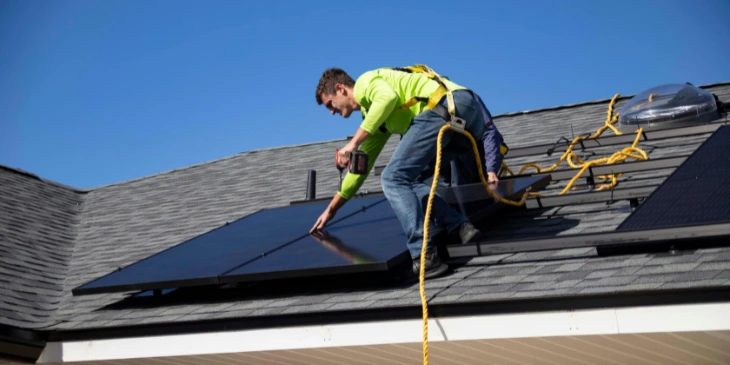
For Birmingham, the mandatory requirement applies across the city's entire new-build pipeline. Areas with active development, including Sutton Coldfield, Ladywood, and Perry Barr, will all fall under the new mandatory rules once they're in force. Any new home whose building notice is submitted after spring 2027 must comply.
Solar moves from being a developer's choice to a government-mandated standard.
Will Every New Build Home Need Solar Panels?
Most will, but not every single one. The government has deliberately designed the FHS with built-in flexibility, and certain properties can be exempt from the mandatory requirement.
The default rule is clear: new homes must include on-site renewable electricity. For the vast majority of new builds across Birmingham, whether that's a semi-detached in Erdington, a new terrace in Hall Green, or a new build in Northfield, solar panels will be fitted as standard.
Where a home's roof can't produce at least 720 kWh per year from solar PV, the mandatory requirement is waived. That threshold covers heavily shaded roofs or very small roof areas where panels would generate too little power to justify the installation.
There's also flexibility built into the 40% coverage target. Where dormers, rooflights, or chimneys prevent full coverage, the regulations allow a lower percentage. The government's rule is designed to be workable: builders don't have to rip back a roof design just to hit a coverage figure.
When Could the New Solar Panel Rules Come Into Force?
The government finalised the Future Homes Standard regulations on 24 March 2026. They come into force on 24 March 2027, with a transitional period running through to 24 March 2028.
Any dwelling whose building notice is submitted after spring 2027 must comply with the FHS. Builders and developers with schemes already in planning have the transitional period to work through those projects.
For buyers in Birmingham, the practical takeaway is simple. Any new home completing from 2027 onwards should have solar panels included as standard, assuming it meets the normal requirements. Developers with sites in Hodge Hill, Selly Oak, Yardley, or anywhere else across the city now have a fixed mandatory date to plan around.
After the transitional period closes in March 2028, there are no further delays. All new homes built in England must meet the new standard.
Are There Any Exemptions to Mandatory Solar Panels on New Homes?
Yes. The government has built in several explicit exemptions and relaxations, known as Limits on Application, to make the mandatory solar rule practical rather than rigid.
Here's how the main exemptions work:
Poor solar potential. If a home's roof can't produce at least 720 kWh per year from PV, the mandatory requirement doesn't apply. This covers shaded sites, properties near tall trees, or homes with very limited usable roof space.
Tall buildings. Any residential building with a storey 18 metres or more above ground is fully exempt. This mainly affects taller apartment blocks rather than standard houses or low-rise flats.
Alternative generation. If a development has access to equivalent renewable electricity via a directly connected system, such as a shared network, the on-site panel requirement is lifted.
Architectural constraints. Where dormers, rooflights, or chimneys prevent 40% PV coverage, a lower percentage is permitted. Builders won't be forced to simplify a roof design to meet a coverage figure.
Alternative technologies. The legal requirement covers renewable electricity generation rather than a specific technology. Other methods can qualify if they produce the needed output, though solar PV will be the default on most new builds.
For guidance on building regulations compliance for your specific site, our vetted local installers are available across Birmingham to help you plan the right approach.
Final Thoughts on Solar Panels being Mandatory on New Homes
This is one of the most clear-cut housing policy changes the UK has seen in years. From 2027, the government makes solar panels mandatory on most new homes in England, and for Birmingham that means cleaner energy built into new housing from day one.
For homebuyers across the city, whether in Edgbaston, Hodge Hill, or Yardley, the mandatory requirement means lower bills from the moment you move in. No arranging the installation separately. Solar arrives with the keys.
For developers and landlords in areas like Perry Barr, Erdington, or Sutton Coldfield, designing panels into new builds now puts you ahead of the mandatory date. Our vetted local installers are already supporting new developments across Birmingham.
Existing homeowners aren't covered by the mandatory rules, but going solar now is still a smart move. Solar Panels Birmingham connects you with vetted local installers, and solar battery storage and solar maintenance and repair services are both available through our network.
Solar on new homes is now government policy. It's coming in 2027, and Birmingham is well placed to benefit. Get in touch and Solar Panels Birmingham will connect you with a vetted local installer to talk through your options.
Solar Panels being Mandatory on New Homes FAQs
Are solar panels already required on new homes in the UK?
Not yet. Solar panels are not mandatory on new homes under current building regulations. The government has confirmed this position clearly, and the mandatory requirement only comes into force on 24 March 2027.
When will the new mandatory rules start?
The Future Homes Standard regulations were finalised in March 2026 and come into force on 24 March 2027. A transitional period runs to 24 March 2028 for projects already in planning.
Does this apply across the whole of the UK?
The Future Homes Standard applies to England only. Wales has its own clean energy standards for new homes, and Scotland has been moving towards a zero emissions buildings approach. For new homes in Birmingham and the wider West Midlands, the FHS is the relevant mandatory framework.
Will every new home have to have solar panels?
Almost all of them, yes. The mandatory requirement applies to most new dwellings, but properties where the roof can't generate at least 720 kWh per year are exempt. Tall buildings with a storey at 18 metres or above are also fully exempt. For most new houses and low-rise flats across Birmingham, the requirement will apply.
What size installation is required?
The government's guidance sets a benchmark of panels covering roughly 40% of a dwelling's ground floor area. For a typical two or three-bedroom house, that's around 10 to 12 panels. Lower coverage is permitted where design constraints apply, provided the system produces a reasonable energy output.
What about existing homes?
The mandatory rules apply only to new builds. Existing Birmingham homeowners are not required to retrofit solar panels. That said, many choose to install panels voluntarily to cut their bills right now. Solar Panels Birmingham connects you with vetted local installers to explore your options.